
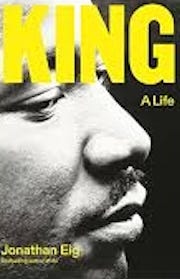
Jonathan Eig's "King: A Life"
Part One: Beginnings to Montgomery

I’ve mentioned in my last couple of posts that I’ve been reading Jonathan Eig’s Pulitzer Prize winning biography of Martin Luther King Jr. It’s an excellent (and long) read and puts King’s ministry in the context of the larger political environment. It is a humanizing telling, willing to address issues of unfaithfulness, depression, faith, and doubt.
Reading the book, I realized how much our understanding of the MLK story unfolds like a children’s book. We go from the Montgomery Bus Boycott to Birmingham to the March on Washington and the Dream Speech to Selma to the Nobel Prize to the Civil Rights Act to Memphis and his assassination. This “Great Man” version of the story not only minimizes the successes and failures of the movement and the man, but it keeps us from seeing the broader social context in which it all happens. That context is essential for us to understand the difficulty of social change that is so necessary today.
Eig begins his story with MLK’s father. I was surprised to learn that MLK Sr.’s name was actually Michael King. He started preaching as ML King and started going by Martin. He added the “Luther” after visiting Germany. His son was originally named Michael, Jr. and then they started changed his name as well. Daddy King, as he was known, graduated from Morehouse and preached in churches in Atlanta. He became the associate pastor at Ebenezer Baptist and then married the pastor’s daughter, who led music at the church. When the pastor died, he became senior pastor. For years, he begged MLK, Jr. to come serve with him.
The next section of the book is on MLK’s education. From Morehouse (at 15) to Crozier Seminary to Boston University. He was enamored with education and philosophy, although he was very free in borrowing passages from other sources. He maintained connection with his educational mentors throughout his life. Eig suggests that, if there hadn’t been the bus boycott, King would have preached a respectable few years at Dexter Avenue Baptist and then taken an academic job.
King was one of the organizational leaders of the Memphis Improvement Association. But more important, he was its voice. Even after their house was bombed in early 1956, they kept on. Speaking from the bombed porch, King said:
I want it to be known the length and breadth of thsi land that if I am stopped this movement will not stop. If I am stopped, our work will not stop. For what we are doing is right, what we are doing is just. And God is with us.
This same sentiment is a constant refrain for MLK. He knew that there were people who wanted to kill him. In September 1956, he was in a department store promoting a book he (and others - but his name) wrote about the bus boycott when a woman stabbed him in the chest with a seven inch letter opener which cut his aorta.
That book was part of effort to build the civil rights movement through the formation of the Southern Christian Leadership Conference. I hadn’t realized how much conflict this created with older groups like the NAACP and the Urban League. Those organizational tensions and the difficulty of funding is a major part of MLK’s story. That’s why he spoke so often; raising money for the organization while still trying to maintain his pastoral role. He was supported by influential figures like James Baldwin, Harry Belafonte, and Eleanor Roosevelt along with his partner (and eventual successor, Ralph Abernathy).
The tensions between protests, organizational development, speaking, and preaching never went away. It’s part of why he slept for only four hours a night and later needed vacations or even hospitalization to manage the stress.
In 1959, Martin and Coretta traveled to India. He had studied Gandhi during his education. They went to Jerusalem and Egypt. Some time after the trip, King agreed to his father’s request and moved the family to Atlanta where we would serve as co-pastor at Ebenezer Baptist. For the rest of his life, he balanced protests, organizational demands, presidential meetings, and preaching at Ebenezer.
It’s a complicated story. Things always seem just out of reach. Too many confrontations. Not enough money for the organization. Personal struggles. Entrenched opposition.
In our efforts at social change, we seem to want an easy answer. If just the “right leader” will emerge all this can be fixed. But that’s not how it works. It’s bigger than any one person and, as becomes clear later in King’s life, far more complex and interconnected than anyone could imagine. But we press on because that’s all we know how to do.