
Not In My Class!
Reflections on recent events at the University of Oklahoma and Texas Tech

Two news events in the higher education world screamed for my attention this week. One involves a student, Samantha Fulnecky, who received a grade of zero on a reaction paper in a lifespan development class because she wrote about her own biblical perspectives. The other, stemming from last summer’s events at Texas Tech, lays out a way to determine when (and if) “controversial material” can be covered in a class. Even though I’ve been retired for five years, I couldn’t help reflecting on these from the context of my years of teaching and administrating in Christian Universities.
OKLAHOMA: Students in the lifespan development course, taught by a graduate teaching assistant, were asked ot read an article and write a reaction paper. As Fox News reported(!), the article was pretty standard fare.
Fulnecky and her classmates were tasked with writing a response to a scholarly article titled “Relations Among Gender Typicality, Peer Relations, and Mental Health During Early Adolescence,” summarizing results of a study about gender norms among middle schoolers and the social ramifications children may face for not conforming to gender norms.
Here is the rubric for grading the reaction papers in the course.

Here is how Fulnecky’s paper begins.

The rest of the essay follows a similar style. While the Chronicle of Higher Ed and Inside Higher Ed had a number of other scholars share their own perspective on how they would apply the rubric, the other grad assistant in the course double-checked the main instructor’s grade. The student received a zero on the assignment worth 25 points. Nobody has said how this single reaction paper fits into the overall grading scheme of the course.
Perhaps a zero was extreme. I probably wouldn’t have gone that far. But it would certainly lose points on each of three criteria, resulting in perhaps 12 out of 25 points.
Of course, that’s not how this case is presented. That Fox News story cited earlier had this headline: “Oklahoma student flunked by TA after touting Christian beliefs in gender essay, directs others to ‘push back’”.
One has to believe that this was the point all along. That’s why TPUSA’s OU group was active in promoting the story. It’s why the student’s first complaint went to the University president and the governor of Oklahoma. Only later did they begin the formal grade appeal process.
As I reflect on this situation, I’m pretty certain that I would have graded this paper down were it in one of my classes teaching sociology at a Christian university. While I’ve never liked the phrase “the integration of faith and learning”, it is a shorthand on what we are trying to do. We want students to bring their faith lives to bear on the course material in ways that make sense of the material while also deepening their faith. This cannot be done by simply parroting what one might hear in a mediocre Sunday sermon.
Were a student to submit this paper, I’d heavily mark it down and ask to meet with the student to discuss what a more substantial engagement might look like. Depending upon the significance of this one paper in the overall course grade, I would offer a chance to rewrite or at least better engage on future work.
Of course, a student trying to make a point could still complain to the president or maybe a congressperson in today’s conflicted social media environment. And I’d have to deal with the consequences. But my response would be that Christian higher education is not just about quoting scripture passages but showing what faithful learning looks like. That’s how I saw my central task over the course of forty years.
Although, the world is changing. What’s happening is public institutions is very likely to spill over into the Christian university sphere. Which brings me to:
TEXAS TECH: Last summer, a student in a children’s literature course became internet famous for sharing video of her confrontation with her instructor (another grad assistant). I wrote about it two months ago today.
This morning, both the Chronicle and Inside Higher Ed had stories about the new guidelines at Texas Tech to clarify how “controversial topics” should be addressed. The Chronicle shared the TTU flowchart.
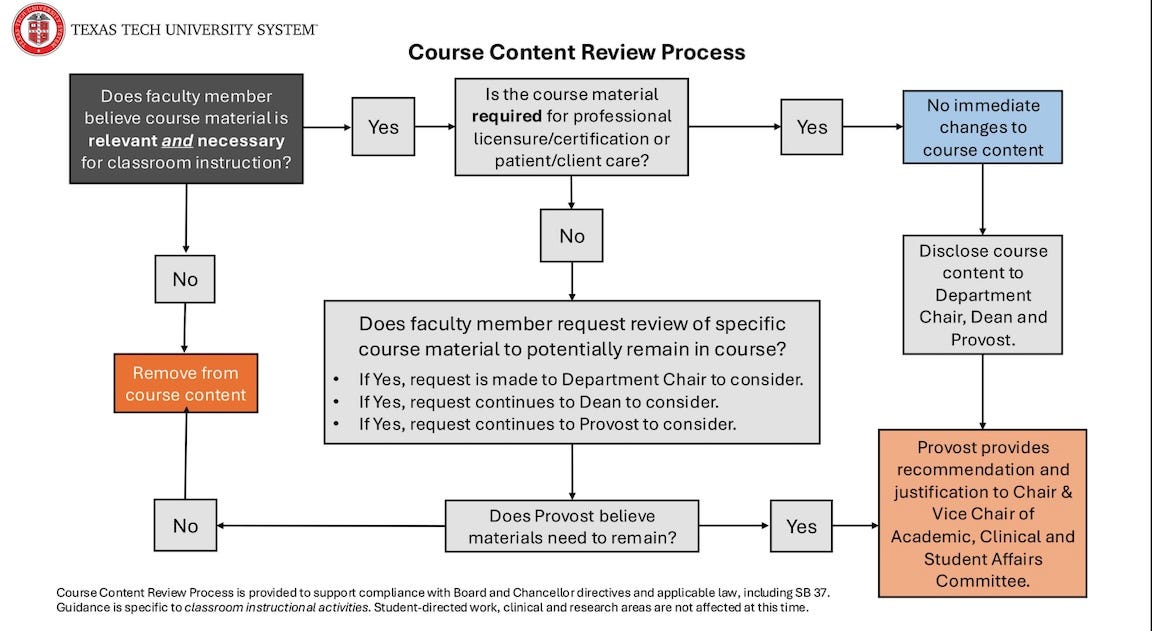
The first question in the flowchart asks if the material is relevant to the course at hand. If not, don’t teach it. That’s fair as an expression of legitimate limitations on academic freedom.
If you read all the way across the top to the right column, it says that IF the course is required for licensure, then content must be disclosed to the higher ups and will, with approval, be recommended for a green light from relevant oversight committees.
But what if your course doesn’t relate to professional licensure? What if you’re just teaching, say, Intro to Sociology to a group of freshmen? Well, in that case your syllabus runs up the chain of command with the department chair and school dean (who may not be in your field). If that passes muster, then it goes to the provost for final determination.
If you want to teach that race is a social construct and also very real or that we all benefit from understanding Marx’s concept of life chances or how the Protestant Ethic related to the development of modern capitalism, you have to rely on others being knowledgable enough to understand what you’re attempting to do with your pedagogy.
And when it gets to the final step, what will the provost do? It depends entirely upon the character of the provost, his academic background, his level of risk aversion, and possibly his own political preferences.
I know what I would have done in my years as VPAA or Provost. I would have sided with the faculty every time. But not everybody is like me. Or when a provost like me leaves, the next provost may have an entirely different set of decision rules on when or if to approve controversial topics.
I could go on for quite a while about the challenges these two cases present to Christian higher education. I expect to return to the topic. As I’ve written in my book and discussed now with faculty from multiple Christian universities, we need to fearless in our teaching and these situations make this exponentially harder unless their are courageous faculty, administrators, trustees, and alums willing to stand against the tide.
Yes, I agree with you, John. I think the 0/25 was way too extreme. Especially given that this assignment was a “reaction essay”. It appears that the rubric left ample opportunity for students to share their own personal feelings and thoughts about the topic, which Samantha did. I likely would have graded her similarly, giving an 8/10 to 10/10 for the paper “providing a thoughtful reaction or response to the article rather than a summary” and a similar 5/5 or 4/5 for the paper being clearly written. I think there was room for the paper to be improved, certainly — especially in the area of demonstrating “a clear tie-in to the assigned article” for which I could see very few if any of the 5 points being awarded. It can be difficult to grade with something this subjective. But I do think a “0” should be reserved for students who don’t complete the assignment at all or who clearly do not make any sort of earnest attempt. I think anywhere from a 12/25 to a 18/25 would have been a more fair assessment. But that’s just my personal thought on the matter! I totally recognize the complexity of the situation and respect other viewpoints as well!
John, I believe that if you had been the instructor, you would have given Fulnecky 12 points out of 25 (which wouldn't have become a national news story as a score of 0 did) and challenged Fulnecky to earn extra points by developing a comprehensive theology of good teasing.