
Remembering Jesse Jackson
Keeping Hope Alive

Spring Arbor University has a sophomore-level core curriculum class that I always nicknamed “finding your place in the universe”. It is officially known as CORE 200 and exposes students — many who come from predominantly white, small-town Michigan — to a larger world. I taught the class a couple of times and always enjoyed it. I had students read about racism, sexual orientation, rural economics, and recovery from gang culture. Other instructors used different readings.
One component of that class was a weekend trip to Chicago. I often drove one of the vans, even in the semesters when I wan’t teaching 200. Using a downtown hostel as a base, the students got to explore Chicago on their own in small groups. (We only came close to losing students once when they went the wrong way on the train.) There were cross-cultural components of the trip as well. We attended Friday prayers at an Islamic Center followed by Q&A and food. On Sunday morning, we attended Lawndale Community Church, with its great history of community redevelopment (followed, of course, by Chicago Deep Dish pizza).
Saturday mornings, though were always the highlight for me. We would shepherd the students onto city buses and head to the South Side where we visited Operation Rainbow PUSH. They had a Saturday morning radio and YouTube program that featured Jesse Jackson and other speakers. They alway gave us a shout-out for SAU being present. After the formal event was over, we were led into the small chapel where we were met by someone from the Jackson family. But early on it was Jesse Jackson himself.
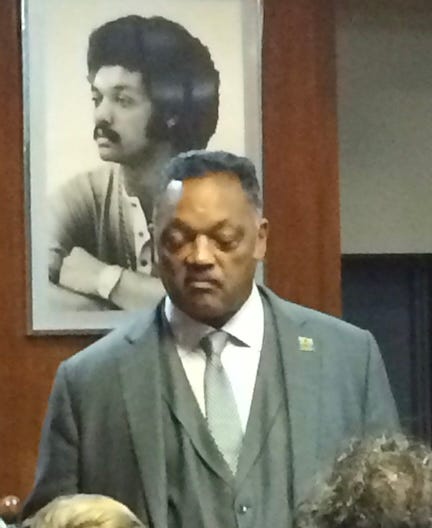
(He’s not mad. I caught him mid-phrase because I wanted the young Jesse picture behind him.)
He would talk about whatever initiatives PUSH had going on, often involving public meetings demanding some corporate response. Over the years, as his Parkinson’s progressed, we saw less of him and more of his sons. When he was there, Jesse would respond to questions by those students brave enough to ask.
Sometimes, they’d give us handouts. I have a Keep Hope Alive t-shirt with Jesse’s head on the front (looks like the painting). The last time I was there, in the fall of 2019, I got a 2000 collection of Jackson’s sermons and speeches titled Keeping Hope Alive.
Of course, our students had little knowledge of what a privilege it was to hear from such an important figure.
But I knew.
Having started my career in the Chicago media market, I was well aware of the role played by Jesse Jackson. He worked with Martin Luther King, Jr. on the disappointing Chicago efforts of 1965.1 Mayor Daley2 (the first one) wasn’t going to relinquish his control over the city, much less addressing the rampant racial inequality of his city. Not surprising, given that Daley was a member of the roving white gangs behind the 1919 Chicago riot.
It was when Jesse Jackson ran in the Democratic presidential primary that I really got a sense of why he was important and the vision he offered the country. In 1984, he faced eventual nominee Walter Mondale and early front-runner Gary Hart3. Jackson finished third, earning 18% of the popular vote and nearly 400 delegates. Even though it was a long-shot, I cast my primary ballot for Jackson.
Four years later, Jackson ran again. I supported him a second time. He finished second to Michael Dukakis. This time, he won 13 contests, had over 1000 delegates, and garnered almost 30% of the popular vote. Dukakis opted for the more centrist running mate of Lloyd Bentsen instead of Jesse.
Since his death yesterday, a number of people have reflected on Jackson’s 1984 Convention Speech, so I listened to it today. A YouTube version is here. I took the hour to listen to it today. It’s a truly remarkable address. In fact, it is precisely the kind of populist message that we need today.
He names all sorts of folks left behind by society or forced into bad choices. He calls out the Nancy Reagan Just Say No approach to drugs and Operation DARE to suggest what it would look like to address the true economics of drugs in America. He speaks of the linkages between health care access and economic vulnerability. It was precisely the kind of interesectional message MLK was using in 1966 and 1967 (which cost him lots of support — more tomorrow). He spoke of the Common Good woven from the quilt-like fabrics of diverstiy.
I also listened to Michael Dukakis’ acceptance speech (admittedly at 1.5 speed — he talks slowly!). His theme seemed to be that his government would be Competent and Ethical. But mostly he was calling to be “Not The Reagan Administration”. He also spoke of community and American values and the need to come together. Frankly, it rang a little hollow. I probably should have listened to him before Jackson.
Jesse Jackson didn’t run again. Imagining an alternative history is always a fool’s errand as conditions are never quite the same. But I came away from his speech thinking two things: 1) he was carrying on the holistic argument of King’s legacy and continued to do so throughout the balance of his career and 2) he was offering the exact critique that spoke to the inequality and militarism expanded in the Reagan administration. I can’t help but wonder how much healthier our society might be today (rendering the Trump presidency unnecessary) if Jesse Jackson had been the Democratic nominee in 1988.
Tomorrow: Today’s politics as echoes of Martin Luther King in the 1960s.
These were largely unsuccessful, as Jonathan Eig’s biography of King make clear. I finished that 550 page book last night and will write more about it in the next couple of days.
I’ve always been amused to remember an anecdote from Mike Royco’s biography of Daley. He recounts how a young Jesse Jackson went to Daley to see how he could be more involved in Chicago politics. Daley offered Jackson a job as a toll both worker on the 294, which Jackson turned down.
Remember when just the hint of scandal undid presidential candidates?