
So What'd I Miss?
I'm back from my SubStack break

Four weeks ago, I wrote that writing this SubStack had become something of a chore and that I needed a break. That’s to those who wrote nice notes of encouragement (and really, to all of my readers).
I still paid attention to the news as much as possible and read some good books, both fiction and nonfiction. But it’s 2026, so I’m Back!
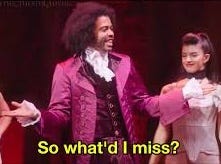
As Daveed Diggs sings as Thomas Jefferson in Hamilton, “So What’d I Miss?” This comes as Jefferson is returning from his stint in Paris. A lot had been going in in his absence.
It would be far too much (and way too depressing) to simply recite all of the newsworthy events that I could comment upon. But I think there are some broad themes that run across the month. They had been going on before I took my break, but not trying to write all the time gave me some distance to evaluate. So, in no particular order…
The Donroe Doctrine: While Trump just announced this over the weekend in response to the taking/kidnapping/arrest of Moduro, he is really naming something that had been going on throughout 2025. He makes a claim (Moduro is a narcoterrorist) and invokes national security to justify his action. There is just enough truth (or more correctly, not enough to prove the claim false) to allow him to do what he wants. His people in the administration double down on whatever he said, Republicans claim to not know anythign about it, and he plows forward with no concern for what happens next.
But this is the same tactic used in attacking higher ed, dismantling programs for trans youth, withholding social safety net funds in Minnesota, and putting the National Guard in American cities. On the last one, he argued that he needed to control crime but the data now shows that crime fell across the board in 2025.
Eventually, courts get involved where outrageous claims have to be reconciled with real live facts. And the administration may have to back down (depending upon how much leeway SCOTUS gives). So the Guard goes home with the promise that they’ll be back if crime rises.1 But by that point, the administration has moved on to the next three outrageous claims and we’re off and running.
Every Crisis Needs a Villain — It’s not enough to claim that someone broke the law or violated procedures. They must be painted as among “the worst of the worst”. This was the rationale originally offered for the immigration crackdown. Albrego Garcia had to be characterized as a vicious gang member and human trafficker. The civil fraud in Minnesota must be seen as the result of an entire nationality of bad actors (led by Congresswoman Omar, of course). Even Maduro’s indictment doesn’t just list the charges but has a bunch of political rhetoric about what kind of leader he was (a bad one).
This villainization has been going on before Trump’s second term. He revels in telling stories of young women (almost always “beautiful young women”) who were killed by undocumented immigrants with past criminal records, It may be the drunk driver in Illinois or the woman knifed on a bus in South Carolina or the woman killed by a stray bulled (accidentally) fired by an undocumented person in San Francisco. But the president seems nonplussed by drunk drivers or domestic violence or mental illness or social safety net fraud if it happens because of white people. For our friends, we cover up and offer pardons (see, Honduras).
The Collapse of Traditional News Media — It’s been four months since I cancelled my Washington Post subscription (but I’ll play their puzzles until May). Far too much of what media critics call “simple stenography” and an unwillingness to risk future access. Too much both-sidesing and weak editorializing (“maybe the ballroom is a good idea”). And that was before the network of Edward R. Murrow, Walter Cronkite, Dan Rather, and John Dickerson became something very different under the new management.2 Paddy Chayefski’s Network was sadly prophetic.
This collapse has made my previous two points that much easier. The news seems compelled to report on whatever claim Trump recently made. Some try in vain to push back on his outrageous statements or Truth Social posts. But he won’t back down. Of all of the things that make me crazy about this president, the top of the list is his trait of repeating his claim three times without elaboration as if that’s the end of the conversation. And for most journalists, it is.
The AI economy — I haven’t been digging too deep into the multitude of AI questions floating in the environment. No longer teaching, I have a safe distance from its impact on higher education. But its disruptive impacts are undeniable. As we learn how to process low-level bureaucratic work with AI, white collar workers will be in the same position as coal miners decades ago; left adrift by an economy that’s moved on.
The people I read regularly on economic topic (Paul Krugman and Catherine Rampell) connect the rise of AI investment to the current strength of the macroeconomic indicators. Ai speculation has masked the negative impact of the cost of living (“the affordability hoaz”) and tariff uncertainty. But we’re now in a K-shaped economy and will be for some time.
One of the books I read this fall that didn’t make the SubStack was Papergirl by Beth Macy. It tells the story of growing up in her town and the struggles to gain a college degree and professional standing as a journalist. It’s an excellent book that explore the various crises that can disrupt the hopes and dreams of far too many lower class small town folks. I really enjoyed the book and was thrilled to learn that Beth is running for a congressional seat in Virginia! We need far more like her.
I got a copy of Andy Weir’s Project Hail Mary for Christmas and enjoyed it very much. I’m looking forward to seeing how it adapts for the big screen (it will be challenging). But right before I read PHM, I read his Artemis. Artemis takes place on a moon base which was thrilling for me because my final course project in restorative justice class was to figure out how to handle security on a moon base. Even on the moon base, social class and immigrant dynamics are real. Scientific crises are managed, but the larger class infrastucture survives intact.3
So these are some random thoughts as I dive back into writing. I’ll have more to say about politics, religion, education, and culture as we move forward. I may not get back to three days a week, but I will try to keep a standard schedule.
Crime fell in all kinds of places, so the presence of the Guard was not a deterrent in spite of claims to the contrary.
Can you imagine remaking Good Night adn Good Luck today? How would Wiess have handled the JFK assassination?
There’s a great defense of smuggling as key to maintaining social order.
Welcome back. Missed your posts!