
Trump's Prayer Breakfast Speech
Which I won't watch

I’ve been part of the Religion News Association (RNA) since 2018. I really enjoy their company and their reporting is excellent. There’s a saying among this group: “Religion is always in the Room”. And a follow-up plea among the Religion News Service (RNS): “Hire more Religion Reporters”.
They are also adamant that the does not stand for “religious”. Even though many of their best writers have history in faith circles and many picked up theology degrees along the way, they focus on religion in all of its expressions. That makes it a great group for a sociologist of religion to hang with.
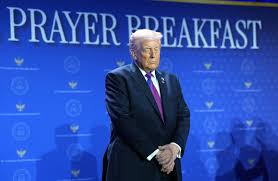
So when Trump delivered his rambling speech at the National Prayer Breakfast yesterday, I was eager to see how RNS would cover it in their morning newsletter. Here’s Jack Jenkins:
In his speech, Trump addressed his own spiritual future, walking back a suggestion he made last year that he might not get into heaven. The president said he had been joking, saying he actually believes he “probably should make it.“
Paula White-Cain, an evangelical minister who headed the White House Faith-Based Office in Trump’s first term, said in introducing the president on Thursday that “no president in modern history, or perhaps all of history, has done more structurally, substantially and sincerely to elevate and protect religious liberty.”
Trump agreed, saying, “I’ve done more for religion than any other president.”
As I said in the subtitle, I refuse to watch it. I did, however, find a transcript and skim through that. If you lift out all of the sections that were simply rehashings of previous steam of consciousness speeches and focus on the religion parts, it’s possible to draw some conclusions.
First, Trump is promoting grievance as always. So the concern about government approach to religion before him deals with issues related to Covid-19 restrictions. Except he exaggerates, talking about all the people who were arrested for their faith (which didn’t happen).
Second, he talks about how his administration will respond when Christians come under attack internationally (in spite of arguments to the contrary from Nigeria).
Most importantly, he praises religion in the abstract, much like Eisenhower did 70 years ago.1 Here is Trump:
And I may be wrong, but I don’t think so, because I’ve watched a lot and I study a lot. You have to have religion. You have to have it. You have to have faith. You have to have God. And thankfully, as we gather today, there are many signs that religion is coming back. And now it’s no longer signs. It’s just coming back. It’s coming back so strong. You know, your churches are filling up. You didn’t have that two years ago.
But when you read his comments in context, he doesn’t mean what Eisenhower did. Faith to Trump is White Evangelical Christians. It’s their agenda he praises, while ignoring every other faith segment (except perhaps Trad Catholics).
This morning in the Bulwark’s Morning Shots newsletter, Andrew Egger wrote an excellent response to Trump’s remarks at the Prayer Breakfast. Andrew regular attends church and sings in the choir. He’s a Hillsdale grad and knows whereof he speaks. Here’s what Andrew wrote:
For American Christians not all-in on MAGA, yesterday’s National Prayer Breakfast was one long parade of bleakness and despair. There was the outrageous presence of Salvadoran President Nayib Bukele, who cast his authoritarianism and barbarity as a God-blessed spiritual struggle against his country’s Satanist gangs. There was the full-service tongue-bath for Donald Trump from speaker after speaker: Televangelist Trump ally Paula White called him “the greatest champion of faith that we have ever had,” a man who has “brought religion back to this nation and beyond.” And there was Trump’s own ordinary barrage of tasteless, cruel obscenity, including in his mockery of the very idea that Democrats would attend the event: “I don’t know how a person of faith can vote for a Democrat, I really don’t,” he said.
But the most interesting moment of the breakfast came when Trump turned briefly to another topic: the contemplation of his own soul.
Unsurprisingly, at his age, Trump has the afterlife on his mind a lot. It pops up at odd times: He’ll be mid-rant about criminal illegals, or the dastardly fake news, or America’s Dawning Golden Age, and suddenly he’ll be giving himself a spiritual scorecard: “I want to try and get to heaven, if possible,” he’ll muse; or “I don’t think there’s anything that’s going to get me into heaven. I think I’m not maybe heaven-bound.”
But yesterday, surrounded by spiritual leaders, political sycophants, and the spiritual leaders who are his biggest political sycophants, Trump offered the clearest formulation yet of his own bespoke soteriology. Don’t worry, he reassured the audience: He’d been mostly kidding when he said he wasn’t heaven-bound. “I really think I probably should make it,” he said. “I mean, I’m not a perfect candidate, but I did a hell of a lot of good for perfect people.”
Hey, you can’t deny the guy’s got a way with words. It’d be hard to come up with a better formulation of Trump’s attitude toward American evangelicalism, its attitude toward him, and why their partnership has become so dangerous for the country.
Trump, whose ignorance of Christianity led to a series of memorable gaffes when he arrived on the political scene a decade ago—citing “Two Corinthians” and dodging questions about his favorite Bible verse—hasn’t seemed to make much spiritual progress in the intervening years. Here he was yesterday, talking about the speaker of the House: “Mike Johnson is a very religious person. He does not hide it. He’ll sometimes say to me at lunch, ‘Sir, may we pray?’ I’ll say, ‘Excuse me? We’re having lunch.’”
In Trump’s view, guys like Johnson are inside the church in a way he is not. But it’s the very fact that he’s outside—unconstrained by the moral scruples that guys like Johnson have1—that makes his particular service to the church valuable. He sees himself as Christianity’s Punisher, the guy who will blacken his own soul to do what must be done to protect the righteous. Yesterday, while discussing his ongoing military campaign against Islamists in Nigeria, he summed it up this way: “When Christians come under attack, they know [their attackers] are going to be attacked violently and viciously by President Trump. I know it’s not a nice thing to say, but that’s the way it is.”
That violently and viciously isn’t just rhetorical window-dressing. This is the service Trump explicitly offers to conservative Christians: There’s dirty work that needs doing. Let me be the one to do it for you. And it isn’t just a political pitch. Trump sincerely seems to believe he has reached a moral accommodation with God for his unique services rendered. “I’m not a perfect candidate, but I did a hell of a lot of good for perfect people.”
This is part of what makes Trump-brand Christianity as a cultural and political force so dangerous. Trump’s political project is seen by the MAGA faithful as utterly righteous, the work of God on earth against the forces of Satan. But he has broad license to transgress all moral boundaries as he does that work. When he does so, it doesn’t cause MAGA Christians to reevaluate whether he’s actually on the side of the angels. Instead, it makes them perversely grateful that he’s doing it so their hands can be clean.
None of this, it should probably go without saying, is compatible in the slightest with the teachings of actual Christianity. Sin is sin, the faith teaches, no matter whom it’s directed against: “Whatever you do to the least of these,” Jesus taught, “you do to me.” The world isn’t divided into “perfect people” on one (political) side and agents of Satan on the other: “All have sinned,” Paul wrote, “and fall short of the glory of God.” Everyone, presidents included, is called to see their own sin with an unsparing eye, feel it in their bones, fall to their knees for forgiveness, spend their lives struggling to turn from it.
Trump doesn’t do this. He doesn’t think he’s obliged to. And why would he? None of the “spiritual leaders” that surround him seem particularly uncomfortable with their arrangement. The loudest Christians in his life have nothing but praise for the way he conducts his business: “the greatest champion of faith that we have ever had.”
I wish I had been as articulate as Andrew in my reactions to the Prayer Breakfast. I pray that more people will take this critique to heart. Otherwise, as I wrote yesterday, the merger of conservative religion and conservative politics is going to do such damage to both faith and democracy that I will take decades to recover from.
“Our form of government has no sense unless it is founded in a deeply felt religious faith, and I don’t care what it is”.