
Will Bunch's Reflections on Brown University
How We Lost The Liberal Arts

It was right about three years ago that I read Will Bunch’s After The Ivory Tower Falls. I wrote about it here and then followed up on his arguments here and here. Bunch’s book was highly influential in my own book about Christian Universities.
Will Bunch is a columnist with the Philadelphia Inquirer. He’s one of my never-miss writers. Yesterday’s column was especially outstanding as he reflected on his undergraduate experience at Brown in light of the university’s recent capitulations to Trump Administration demands. I’m going to quote heavily from his piece and add my own reflections along the way.
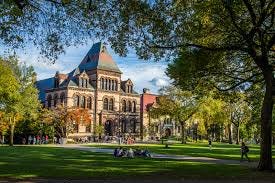
[I] came to understand that Brown’s progressive ideas about what made for a world-class education might be a good fit, if they’d have me. I’d like to say it was their brilliant roster of professors that clinched it, but in reality I fell for Brown during a 12th-grade visit on an unseasonably-warm Saturday in March, as Frisbees flew across fresh grass on the Wriston Quad and the Allman Brothers’ “Jessica” blasted from someone’s massive speakers.
And, since we’re being honest, also the rejection letter from Harvard that came a month later.
Bunch is five years younger than I am, so he graduated from Brown the year I started teaching sociology at Olivet Nazarene. While my Christian university didn’t have the grand designs of Brown’s “Open Curriculum”, the sense that liberal arts were in fact liberating was present even on our little campus.
I should mention some less sexy and more relevant things that happened to me between September 1977 and May 1981. Now that the haze of 2 a.m. nights putting out the Brown Daily Herald and 4 a.m. jaunts to Haven Brothers has lifted, I understand how much I got out of Brown’s then-New Curriculum (now, the Open Curriculum) that 1969 student activists had fought for, to ensure their successors got a diverse and liberal (in the classical, not political, sense) education.
That’s how a late boomer inspired by the anti-war protesters who’d come before me ended up in a seminar class called “Military Influence in America” taught by a retired colonel, and later in a poli-sci class taught by the former No. 3 man in the CIA. Brown allowed students to take any class pass/fail in those days, to encourage students to broaden their wings. I took courses nicknamed “Econ for Poets” and “Notions of Oceans,” and tiny neurons of knowledge remain decades later when I write about the evils of unfettered capitalism, or the threat of climate change.
I didn’t go to class for my career. That’s what the Herald and summer internships were for. I wanted to read the great books, and develop an appreciation for things I’d known nothing about, like modern art. Learning facts was less important than learning to think — so hopefully I wouldn’t stop thinking once I turned 23.
Clearly, Will knew at an early age that he was headed toward journalism.1 But he wasn’t looking for the university to provide him with a vocation, not when he could be focused on the larger issues of self, society, and ethics.
In 1969, a whopping 83% of nationwide incoming college freshmen told UCLA researchers their purpose in going to college was “to develop a meaningful philosophy of life.” At Brown in the 1970s, that number might have been higher.
Fifty years later, in the last CIRP freshman survey UCLA did, 75% of respondents said it was very important “to gain a general education and appreciation of ideas.” Only half said that college should make them “a more cultured person.” Over 80% said that college was about “getting a better job” or that they wanted to “learn more about their interests.’ Nearly as many (78%) said that were “getting training for a specific career.”
I would have loved teaching in an Open Curriculum with classes that were topical, fun, and had sexy titles. A few times I got to take a risk with a short-course during January2, but I mostly taught Intro to Sociology as my general education course.
As schools felt the pressure to become more vocational in orientation, major curricula got more proscribed. Even in Christian liberal arts institutions, certain departments (engineering, nursing, finance/accounting) pressured curriculum committees to shrink the overall general education requirements so that students could complete in four years (or less). Often these programs had a very small number of electives through which students could explore broader ideas.
A tell-tale sign that the culture was shifting is that general education became something “to get out of the way”. Rather than explaining the intrinsic value in a course like “Econ for Poets”, advisors often counseled students to take their bitter medicine of general education so that they could focus on the Real Stuff of the major. I fought this battle (and lost) in every institution I served. Bunch picks up similar themes at Brown.
The liberal curriculum largely remained, but the spirit of 1969 felt increasingly buried under a mound of money. As an institution, Brown tweaked its focus more toward big-name, big dollar research in programs like a bulked-up School of Engineering. More hedge-fund alums started bringing a Wall Street attitude to the board of trustees. As job prep trumped that whole “meaningful philosophy of life” thing, preprofessionalism and career-trajectory clubs proliferated.
With so much ambition on the line, Brown became too big to fail.
I think we can draw a pretty straight line between the shift from liberal arts to professionalism on the one hand and current attitudes toward higher education on the other. Increasingly, politicians and trustees talk of “workforce development”. They institute an earnings metric to measure program success, minimizing liberal arts fields even as they seek to demolish majors and cut faculty. Besides, those “philosophy of life” people might ask critical questions of a rising authoritarianism. As Bunch observes:
And it really doesn’t matter what was preserved in the deal. Academic freedom is kind of like virginity. You don’t lose it just “a little bit,” nor can you get it back when it’s gone — at least not so easily.
Perhaps the real solution to our current moment is for universities to re-imagine their long-standing commitments to academic freedom and open discourse. As I argue in my book, the answer to the Big Questions of the day — whether vague accusations of antisemitism or support for LGBTQ students — is to embrace them as serious academic subjects. Of course, the critics don’t want that. They want the topics not to be addressed at all.
So the Trump administration clamps down on financial grants to universities that had already been awarded. States want “divisive topics” to be kept out of classes. Institutional leaders adopt the pre-professional metrics to justify further marginalizing liberal arts coursework.
Will Bunch says it well.
Brown is spending $50 million over 10 years on Rhode Island workforce development, a worthy cause. The spigot for worthwhile and maybe lifesaving science suddenly reopened. All Brown had to give up was...
...its mortal soul.
This is a story that can be told again and again across the higher education landscape. For some institutions, this is due to attacks from the government with uncertain motives and no chance of ever satisfying the critics.
For far too many others, they have long ago abandoned “their mortal soul”. They now find themselves incapable to making a compelling case for having their students develop as whole people who can look critically at the world and operate with integrity wherever they flourish.
It’s one of my alternate universe careers. My parents met on the student paper at Butler University.
One of my favorites was teaching a “sociology of small towns” course in central Kansas.
There is a need for Liberal Arts Education. Fareed Zakaria articulates this need clearly in his book.
The question is: How can we do it?
The answer for me is to do it in a way that is completely different than before and at the same time, (paradoxically}, do it the way it was done a long time ago. Go back to the academy. That is why I am starting with some friends, what we call, The Hub. https://steam-hub.academy
I will be teaching physics again this semester, but I am framing it as Physics: A Pathway to a Prosperous and Meaningful Life. [(Natural) Philosophy 221]
Such truth in today’s world. “Nine days after the announcement of the “Courage from the Margins” research grant to the Center for Church and Community Impact at Baylor University’s Diana R. Garland School of Social Work, the university announced the $643,401 grant had been voluntarily rescinded.
When I first heard that the Eula Mae and John Baugh Foundation had announced a grant to Baylor University’s school of social work for a study of what religious congregations do and do not do in their caring practices with all people, including women and LGBT individuals, I was so proud of Baylor University…”
https://bubearsforall.org/featured-articles/baylors-rejection-of-baugh-foundation-grants